
🐉 Dragon Chinese Zodiac Meaning
Dragon — 龙 (Lóng) — is known as The Sovereign Vision-Bearer in the Chinese zodiac. This guide walks through dragon personality, relationships, work themes and spiritual lessons, and how your dragon energy can combine with Wood, Fire, Earth, Metal and Water in the 60-year cycle, plus how it shows up in Four Pillars (BaZi) and 10-year luck pillars (Da Yun).
Quick Snapshot
Strengths: Magnetic, ambitious, courageous, inspiring, imaginative.
Challenges: Can be prideful, intense, controlling or all-or-nothing.
Compatible with: Often compatible with Rat, Monkey, Rooster.
Clashes with: Tends to clash with Dog, and sometimes Rabbit or Ox.
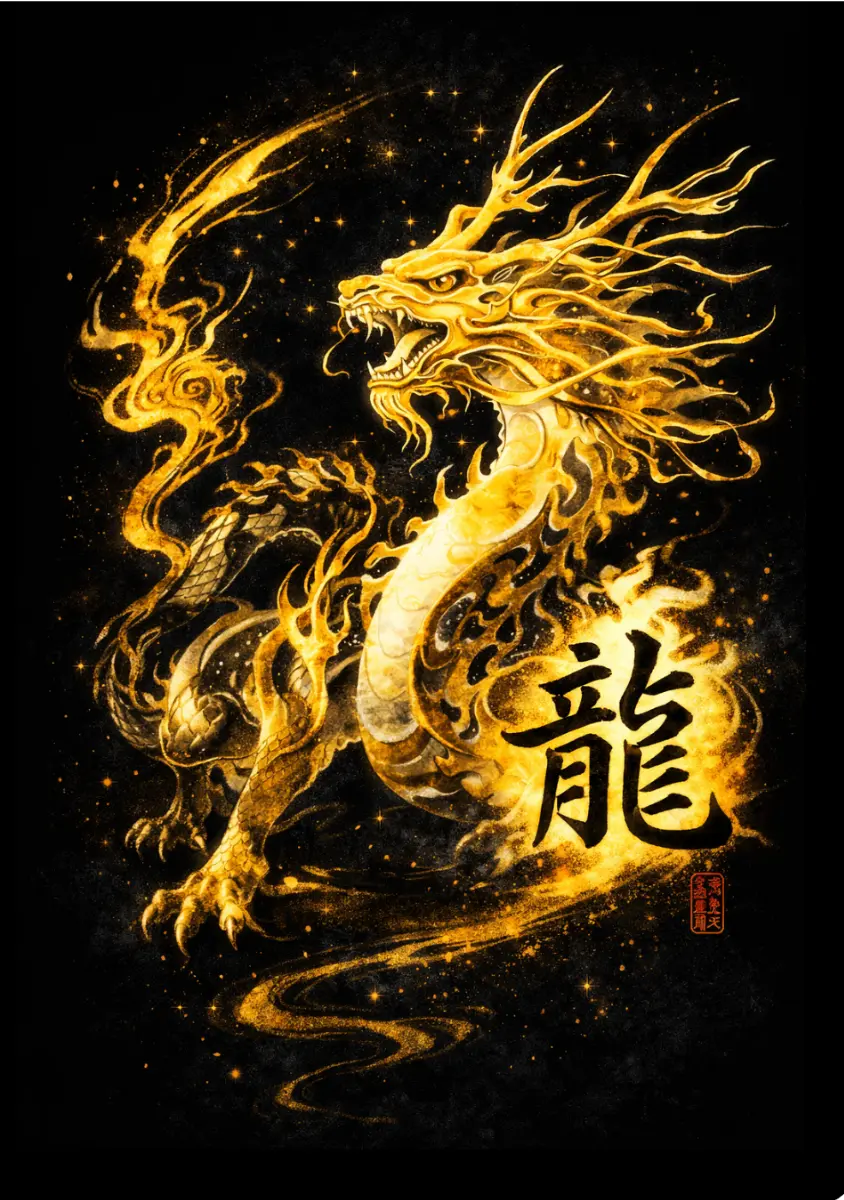
The Dragon is the most legendary figure in the Chinese zodiac, symbolizing power, charisma and grand destiny. Unlike the other animals, the Dragon is mythic, representing the part of humanity that transcends limitation and breaks patterns. In classical Chinese culture, the Dragon is linked to heavenly authority and the Mandate of Heaven, so Dragon natives are often said to carry fate that feels larger than life. Even when you are quiet, there is a sense of bigness about you—big potential, big feelings, big turning points. Dragon years and Dragon people tend to coincide with dramatic shifts, bold moves and visible story arcs.
Dragon Personality & Archetype
At its core, Dragon energy is sovereign: visionary, commanding, courageous, noble and naturally magnetic. You are wired to see the whole story, not just the next step, and your presence alone can shift a room. Psychologically, Dragons carry big expectations—there is an inner sense of being meant for something significant, whether that shows up as leadership, creative impact, spiritual work or cultural influence. Even when you are not competing with others, you compete with your own potential. You often have a strong moral compass and a deep dislike for betrayal, hypocrisy or cowardice. Autonomy matters: you do not like being micromanaged and can follow a leader only if you genuinely respect them. Underneath the confidence, Dragons are actually very sensitive; feelings run hot and deep but pride can make vulnerability hard to show. Emotionally, you are like a volcano—quiet on the surface, molten at the core—learning over time how to express intensity in a grounded, honest way.
Dragon in Love & Relationships
In love, Dragons tend to love intensely, protect fiercely and commit fully when you are truly in. You are drawn to bonds that feel alive, purposeful and inspiring, not lukewarm arrangements. At a heart level, Dragons want respect, admiration, loyalty, emotional depth, intellectual connection and a sense of shared adventure or mission. At your best, you uplift your partner, defend the relationship, take initiative and bring warmth, generosity and passion into the bond. You can be romantic and grand in your gestures, wanting your partner to feel chosen and cherished. The challenges often show up as pride, difficulty apologizing, jealousy, impatience or wanting perfection. Sometimes you may test people unconsciously before fully trusting them, or stay in the heroic role instead of letting yourself be seen in your softness. Your growth edge in relationships is allowing genuine vulnerability—letting someone witness your doubts and fears—without feeling like your power disappears when you do.
Dragon at Work, Money & Luck
Career-wise, Dragons are born for environments where courage, vision, risk, creativity and leadership actually matter. You thrive when you can build something larger than life—whether that is a business, a movement, a creative body of work, a community or a legacy project. Ideal arenas include entrepreneurship, politics, media and entertainment, art, film, performance, technology and innovation, high-stakes strategy, the military or law enforcement, spiritual or esoteric leadership, coaching, public speaking and social or philanthropic leadership. Even when you are working solo, Dragon energy tends to produce projects with scale or visibility. You are more suited to being a builder of movements than a cog in someone else’s machine. With money, you may swing between bold investing or risk-taking and periods of intense focus on security; finances often mirror the size of your ambitions. Over time, you prosper most when your power and influence are used in service of something beyond ego—causes, communities, creative visions or long-term legacy rather than just personal status.
Growth Path & Spiritual Lessons for the Dragon
On a spiritual and psychological level, the Dragon’s path is about mastering power rather than being mastered by it. The shadow side can show up as arrogance, stubborn pride, perfectionism, explosive anger, over-controlling tendencies, all-or-nothing reactions, unrealistic expectations and emotional withdrawal when hurt. Dragons must learn that power without wisdom destroys, while power with wisdom creates. Hidden inside the Dragon’s earthly branch are energies linked to stability, growth and intuition, hinting that your inner world is far softer and wiser than your outer armor might suggest. Life often follows an archetypal Dragon journey: feeling different or destined for more in youth, facing trial-by-fire experiences in early adulthood, rising into real influence or mastery around midlife and eventually thinking in terms of legacy—what you built, healed, protected or transformed. Compatibility-wise, Dragons often resonate strongly with Rat, Monkey and Rooster energy, while Dog and some Rabbit or Ox dynamics can feel more challenging or ideological. Ultimately, your spiritual evolution is about transforming “I must prove my greatness” into “I let my gifts uplift and protect others.” In Taroscoper readings, Dragon natives tend to appear as destiny-carriers whose true task is to wield their charisma and willpower with integrity, humility and a conscious commitment to the collective good.
Elements & 60-Year Cycle — Wood, Fire, Earth, Metal, Water Dragon
In Chinese astrology, every dragon year appears in five different elemental flavors over a 60-year cycle: Wood Dragon, Fire Dragon, Earth Dragon, Metal (Gold) Dragon and Water Dragon. The animal describes your core archetype; the element and Yin/Yang quality describe how that archetype behaves — more outward and bold, or inward and receptive. In Taroscoper's calculator, when you enter your birthday you'll see your specific combination (for example, a Yin Water Dragon or Yang Metal Dragon) and how it interacts with your Western zodiac sign and Destiny Matrix numbers.
Wood Dragon: Wood adds growth, learning and creativity to the dragon archetype. Wood Dragon natives often feel driven to explore new ideas, develop skills and expand their world. Their energy tends to be more idealistic and future-oriented, pushing the dragon to evolve rather than stay stuck in old patterns.
Fire Dragon: Fire brings passion, charisma and visibility. Fire Dragon types express the animal's archetype in a dramatic, noticeable way—through body language, style, leadership or performance. This flavor is bold, expressive and sometimes intense, needing conscious channeling so that enthusiasm doesn't turn into burnout or conflict.
Earth Dragon: Earth grounds the dragon energy into stability, practicality and long-term building. Earth Dragon natives want something solid to show for their efforts—whether that's money, reputation, home or mastery. This combination can be reliable and steady, but may also resist change until the pressure to grow becomes undeniable.
Metal (Gold) Dragon: Metal sharpens the dragon archetype into focus, standards and discernment. Metal Dragon people often have strong opinions about what feels right, efficient or worthy of effort. At best, they embody clarity and integrity; at worst, they may become overly critical of themselves or others when ideals are not met.
Water Dragon: Water makes the dragon more intuitive, emotional and fluid. Water Dragon natives tend to feel things deeply, read between the lines and adapt to changing circumstances. Their challenge is balancing sensitivity with boundaries so they don't get swept away by moods, relationships or the environment.
When you read "Fire Dragon" or "Water Dragon" in your chart or in a yearly forecast, imagine the same core archetype moving through a different element costume—same animal, different style of expression.
Dragon in the Four Pillars — Year, Month, Day & Hour
In Four Pillars of Destiny (BaZi), the dragon can appear in your Year, Month, Day or Hour pillar. The stem (Heavenly Stem) shows an element; the branch (Earthly Branch) carries the animal. Where the dragon sits in your chart changes how you experience its energy.
Year Pillar Dragon — Generation & Aura: When the dragon sits in the Year pillar, its archetype colors your generation imprint and public aura. People may read you through this energy at a distance—online, in groups or by reputation. It describes the “field” you were born into: collective mood, cultural lessons and the type of tribe you naturally attract.
Month Pillar Dragon — Family & Work Style: In the Month pillar, the dragon shows your early environment, family conditioning and career style. It influences how you show up in teams, how you handle responsibility and what kind of work climate suits you. A dragon month pillar may make you embody this sign's traits strongly at work or in your role within family systems.
Day Pillar Dragon — Core Self & Partner Field: The Day pillar—especially the Day stem—is often treated as your Day Master, symbolizing your core self. When the dragon is in the Day branch, it also colors your intimate life and partner field. It describes how you experience closeness, what kind of energy you attract in relationships and how you behave when your guard is down.
Hour Pillar Dragon — Inner World & Late Life: In the Hour pillar, the dragon moves into your hidden self, late life themes and long-term projects. It may describe your subconscious patterns, your relationship to children or creative “legacy” work and what life feels like when you're no longer performing for anyone else. This is often the Dragon energy you discover gradually as you age.
Seeing the dragon repeat in multiple pillars (for example, Year and Day) amplifies its role in your story, making its strengths, shadow traits and life lessons especially central in Taroscoper-style readings.
Dragon & 10-Year Luck Pillars (Da Yun)
In BaZi, Da Yun are 10-year luck pillars that describe the major themes of each decade of your life. Each pillar combines a Heavenly Stem (element) and Earthly Branch (animal). When a luck pillar, year or major transit involves the dragon, it can activate this sign's story arc in a stronger way.
When a Luck Pillar Features the Dragon: Entering a dragon luck pillar often feels like stepping into a dragon-themed chapter—where the sign's core traits become more obvious. For example, you may notice:
- More people with dragon-like energy entering your life.
- Situations that trigger both the strengths and challenges of the dragon.
- A push to embody this archetype more consciously instead of acting it out on autopilot.
Supportive vs. Challenging Cycles: How smooth a dragon luck pillar feels depends on its element combo and how it interacts with your natal chart. A pillar whose element supports your Day Master may feel like a “green light” period; a pillar whose element clashes can feel more like training, upgrades and necessary plot twists.
Dragon Years as Activators: Even outside your 10-year pillars, individual Dragon years in the 12-year cycle can act as activation points. If you were born in a dragon year, these returns often mark identity resets, level-ups or big decisions. If the dragon sits in another pillar, that part of life—family, work, relationships or inner world—may receive special focus that year.
Using Taroscoper with BaZi & Luck Cycles: On Taroscoper, you can first find your Dragon year, element and Yin/Yang in the main Chinese zodiac calculator. Then, if you know your approximate birth time, the Four Pillars + Luck Pillars tool shows how often the dragon appears and where it tends to light up over your lifetime—helpful context for timing projects, moves and personal growth work.
Explore more Taroscoper tools: